BOW WHARF AT KING ALFRED

Christmas is a’coming and it’s time for writing groups to set aside time for a good meal and to entertain themselves with seasonal pieces. In such a spirit Bow Wharf Writers from Langport met up for lunch at the King Alfred Inn, Burrowbridge and an excellent meal it was. I say from Langport, the group meets in Langport, but members come from close by and far afield.

Nine people sat down for lunch and to be entertained, there were poems a plenty, short stories on Christmas themes, including a winter ghost story and a two handed short play through all of which the hard working Inn staff kept the main courses, puddings and coffees coming.

A great menu of food and writing – maybe even a few resolutions to make next year the one to write that breakthrough piece. So here’s a toast to 2016 and The Bow Wharf Writers.

Posted in Writing Groups | Tagged , | Leave a comment

What a muddle.

My last looked very odd for a day – the whole text went into the title. I seem to have a computer problem, but have sorted it now posting from my Kindle. Sorry folks for the muddle!

Posted in Uncategorized | Leave a comment

A morning well spent.

A morning well spent. Recent gales brought down the top half of a beech tree, not a high tree, but a hedge growth that had been uncut for more than thirty years. It had developed a weak spot midway up its trunk where the damage had let the weather into its growth. The gale was the trigger and it crashed down across a gateway. We didn’t hear it fall, but it is good fortune that no person or livestock was at the gate. So a couple of hours with a pole saw and chain saw, first taking off any growth not bearing pressure on the ground or the adjacent hedge bank, then tackling the load bearing timbers until the trunk was safely landed.

The wood was cut to size, picked up using the quad and trailer and carted to the wood store. In two or three years it will be sawn for logs for winter burning.

A good morning’s work, only it is a tad ironic that if the gale had not blown, the tree would not have fallen and the task would not have been needed. Still there is satisfaction over a coffee by the stove later for a job well done.

Posted in Uncategorized | Leave a comment

BACK TO THE BOOKER

It is worth looking at how the winning vote has fallen over the fifty awards since the prize was first awarded in 1969 – there have been years with two awards. The criteria have been for novels nominated by publishers, published in the current year, in English, in the United Kingdom. Over time it has been open only to Commonwealth plus Ireland and Zimbabwe writers, but this has now changed. Since 2013 the award is open to writers of all nationalities writing in English and published in the UK.

As yet there has not been a winner outside the original criteria. Since 1969 UK and Irish writers have dominated winning the prize 31 times, Australian writers have succeeded 4 times, South African, Canadian, New Zealand and Indian writers each on 3 occasions, Caribbean writers twice – VS Naipaul in 1971 and Marlon James this year and a Nigerian writer once – Ben Okri’s, The Famished Road in 1991. Three writers have won ‘the Booker’ twice: JG Farrell, JM Coetzee and Hilary Mantel. Salman Rushdie, the winner with Midnight’s Children in 1981, also won the ‘Booker of Bookers’ in 1993, celebrating 25 years of the prize.

Some years there is said to have been unanimity amongst judges, other years there have been disputes, sometimes public. Prize-winners, and to a lesser extent short-listed writers, gain publicity, thus at heart the competition with entrants nominated by publishers, is sales driven and relates to a particular book. There has been division on the merits of widening the national eligibility of writers – it will be of interest to see how this impacts and whether ‘Commonwealth’ writers hold their dominant place as Booker prize-winners on an international stage.

The Man Booker International Prize differs in that it is for authors’ whole body of work and nominated by judges on their own assessment, not by publishers.

Posted in Uncategorized | Tagged | Leave a comment

THE THIRD YEOVIL LITERARY FESTIVAL

The 2015 Festival ran on the last days of October and into November bringing many authors and performers to The Octagon, The Manor Hotel and Yeovil Library. I was able to be there on two of the four days, getting on the Thursday to Tristram Hunt giving a fascinating account of Ten Cities that made an Empire, and to Michael and Clare Morpurgo with Natalie Walter and Voices at the Door bringing alive the poetry and music in their childhood recollection Where My Wellies Take Me concert.

On the Friday I joined with other Yeovil Literary Prize winners to give readings of prize poems, novels and short stories, then to the library to hear Veronica Henry, wretchedly delayed by the current traffic chaos in the town, but still giving an hour long talk of her writing life and latest novel High Tide.

Later Cathy Rentzenbrink, supported by three generations of her family, gave a frank and moving account of the years after her brother was brain injured when knocked down by a vehicle, the eight years of his life after the accident and the realizations and awful decisions the family faced. Cathy’s memoir The Last Act of Love is a brave work, greatly valued by the medical and legal community working with families in such circumstance.

In the evening Paddy Ashdown filled the hall at the Manor Hotel with his account, The Cruel Victory, of the Marquisard fighters who defended the plateau that lies between the Rhone and Le Route Napolean in the South of France thus supporting the D Day landings by diverting Nazi forces from the Allied invasion. Brave men little celebrated outside France.

There were many other events. The Festival has been a huge success; congratulations to Liz Pike and all who gave their time and effort to ensure that achievement.

The Fourth Yeovil Literary Festival will take place on and between 20th and 24th October 2016 – a date for your diaries.

Posted in Yeovil Literary Festival | Tagged , , , , , | Leave a comment

SHADES OF EMPIRE

Tristram Hunt spoke about his book Ten Cities that made an Empire at the Yeovil Literary Festival this week.

Amongst the key cities of the British Empire featured in Hunt’s book are Hong Kong and Liverpool, two cities I have worked in, both linked in differing ways to China, the former returned to China after 150 years of British rule in 1997, the latter after years of sea trading with the Orient now has an apparent ambition to be the Shanghai of the Western World based on significant Chinese investment.

As a resident of West Somerset where our ‘Kow Tow-ing’ politicians appear to have ceded a part of the Hinkley Point landscape to the Chinese, and the happenings in the South China Sea where the Chinese are building artificial islands to claim extended territorial waters, one wonders if we are witnessing the birth of the International Chinese Empire.

Still we can be pleased to learn that after the recent meeting of the Chinese Communist elite we will be allowed ‘Two’ rather than ‘One’ power station.

Posted in China, Empire, HONG KONG, Liverpool | Tagged , | Leave a comment

YEOVIL BOOK GROUP

The Yeovil Community Arts Association (YCAA) Book Group meets at the Octagon Theatre in Yeovil every month with two books to discuss, to debate, often to disagree and generally give each chosen book a good airing amongst a group of people with a spread of ages.

I have been going to this group for eighteen months and wish I had for longer. I doubt I would have read any of the books discussed, but for the group. It has taken me out of my zone of choice and introduced many good writers that I would have passed by and will now seek out again, and a few I won’t.

The group met earlier this week in the wake of the Man Booker competition where everyone made their own choice of shortlisted book to read and present. This after the YCAA ‘Man Booker Debate’ the week before where a six person panel, drawn from writers, academics and, on this occasion, the local MP, had each been given to read and champion one of the short listed books.

The Man Booker short list was:

A Brief History of Seven Killings – Marion James,  A Little Life – Hanya Yanagihara,            A Spool of Blue Thread – Anne Tyler, Satin Island – Tom McCarthy, The Fishermen – Chigozie Obioma, and The Year of the Runaways – Sunjeeve Sahota

During the Book Group discussion A Little Life, A Spool of Blue Thread and The Year of the Runaways were all well supported and thought to have opened a window onto lives led in unexpected, but real circumstance. There was support round the table for any of these three to have won the prize.

By strange chance none of the Book Group had chosen to read A Brief History of Seven Killings, the winner of the 2015 Man Booker Prize.

Posted in Book Groups | Tagged , , | 3 Comments

A Biography Workshop

On Sunday 11th  October I went to a writing workshop – The Biographer’s Tale – with the Writer-in-Residence at Coleridge Cottage in Nether Stowey, Rose Collis. It was an informative afternoon, the only problem was that publicity had not hit its targets and I was the only attendee on the twelve place course.

It made it hard for Rose running the workshop, but gave me two hours of individual attention. Rose Collis has been many things as well as a writer and the afternoon might well have brought back memories of her performing days on stage when a modest audience turns up to a performance. But the show must go on and it did.

The afternoon took us (me) through the generation of biographic ideas, the objectives and sources of research, not least these dictums:

  1. What do we think?
  2. What do we know?
  3. What can we prove?

Although I am not a writer of biographies, I do need to research the places and times in which I set my stories.

Also I have access to family papers from the early 1800s that provide the bones of fascinating situations; in a first case an heir being disinherited and in a second case a diary of a Yorkshire woollen goods merchant making business trips in 1821 over the Pennines by carriage and by sea in sailing packets to Ireland and the adventures those travels entailed.

The workshop on biography gave me real help in how to approach the writing of these tales.

Posted in Biography, Writer in Residence | Tagged , | Leave a comment

Literary Festivals in Somerset

In Somerset both Yeovil and Taunton have Literary Festivals coming shortly. Yeovil’s is at the end of October – the 28th through to 1st November – and Taunton’s for three weeks in November, the 7th to 28th of the month. Both have much to entertain book lovers.

The Yeovil Literary Festival is a partnership between Watersons, Yeovil Community Arts Association, Yeovil Library and The Octagon Theatre. Many well known names will be there – Michael Morpurgo, Veronica Henry, Paddy Ashdown, Margaret Graham, Judith Kerr, Robert Winston, Jacqueline Wilson and Max Hastings to name a few, and to whet the appetite.

I have booked my tickets (The Octagon box office) and I have a modest slot on the Friday as winner of the 2015 Yeovil Prize Short Story Competition. See you there.

The Fifth Taunton Literary Festival is presented by Brendon Books, Taunton’s independent bookshop, also the venue for many of the talks. Gervase Phinn, Rachel Billington, Vince Cable, Martin Bell, Gulwali Passarly, Hilary Bradt, Kate Lord Brown and others will all be taking part during the three weeks.

And local writer Chella Ramanan’s Radio play, The Garden, is one to catch, Sunday 22nd , 7pm at Brendon Books. During past months this has moved on from the first words on the page to a full script, to casting and recording.

I’ve not booked tickets yet, but will be doing so soon – the place to go is Brendon Books or on the website.

.

Posted in Literary Festivals | Tagged , , | Leave a comment

COAST PATH TO HINKLEY

Yesterday we walked along the South West Coast Path, the one that goes along the Bristol Channel Somerset shore from Minehead to Steart joining the River Parrett Trail. 6-IMG_0578 It passes Hinkley Point, only now it is diverted round the power station site and no longer goes along the sea wall. There is no physical need for the closure of the sea wall path, the planned developments don’t encroach. No doubt the ‘security’ argument won the day and the path was closed; will it ever re-open?

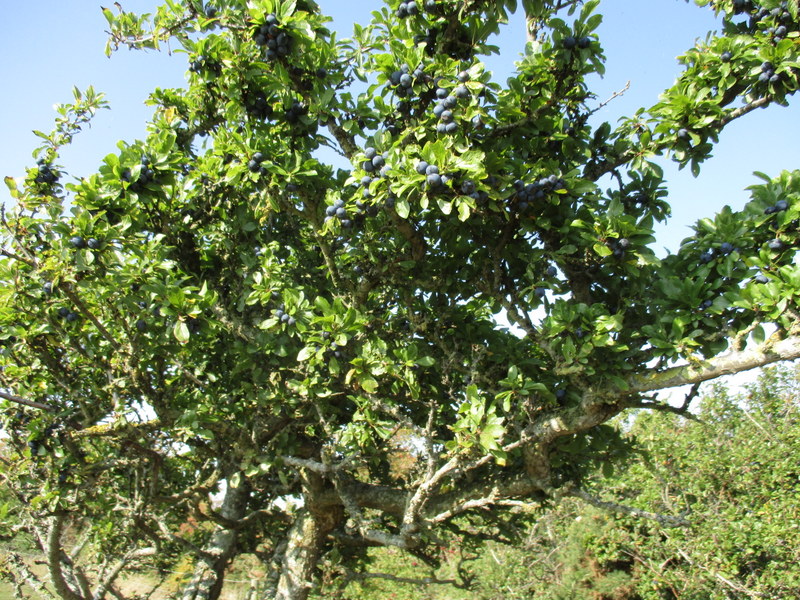
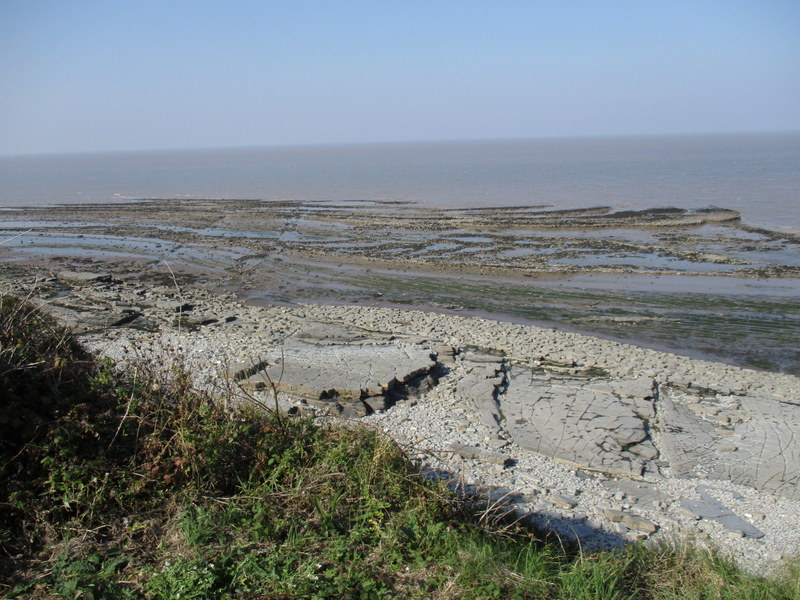
We picked up the path at Lilstock and walked eastbound above the crumbling cliffs with a spring tide ebbing to reveal great patterns in the geology of the seabed. In the sun-drenched weather of the past ten days the wild autumn harvest has ripened into a bumper crop amongst the brambles and scrub that cling to the cliffs along much of the path. A huge blackberry crop is joined by sloes and what must be wild damsons – or are they all the same wild plums? Rosehips in thousands hang in the trees, while a herd of young heifers munch their progress through the tough sea-border meadow. 3-IMG_0586A powerful tractor pulled a cultivator across a field, the stones clattering its metalwork before another tractor followed to spread lime. No doubt the lime was brought from miles away? Embedded under the cliff below us the remains of once working lime kilns are still to be found with evidence of a stone-laid track-way through the rough shingle down to the sea for the lime to be carted and loaded onto the working ketches that sailed in their hundreds along the Bristol Channel shores in past centuries.

Our glimpse over the barrier into the nuclear site, wanting to see what progress the Franco-Chinese developers of the power station are making, must have been observed on CCTV as a patrol car soon made its appearance on the other side of the boundary. A Hungarian border style fence seals off the site, yet a flickering butterfly danced over the summer grass weaving its passage through the fence and back oblivious of the things happening in its short-lived world.

4-IMG_0587Would Coleridge in the 1790s, his head full of words and with his Jacobite leanings, striding over from his not far distant cottage in Nether Stowey, have taken kindly to authority’s restrictions?

We turned and retraced our walk, pausing a while on the cliff top to watch two migrant white egrets feeding long-legged across low-tide-revealed pools. Before moving on we scrumped a handful of sun-ripened blackberries to savour their fruitfulness and speed our way home.

Posted in Coast Path, Hinkley Point | Tagged , , | 1 Comment